
01The challenge
Case-study scope: This is a proposed broadband design concept from the supplied case study, not a confirmed completed deployment or measured service result. The island and routes are illustrative; no exact location, client, budget, schedule, capacity, speeds, or uptime results are provided. All figures and resilience claims require validation during survey and engineering.
Download the supplied case-study report (Word)
The case study considers a remote Philippine island with three towns spread along a hilly coast. Distance from mainland infrastructure, routine power interruptions, typhoons, salt air and limited local technical support make a conventional single-path network difficult to maintain. The design goal is dependable connectivity for homes, schools, LGUs, businesses and public-safety services, including during adverse conditions.
The proposal connects a solar-powered hub in the main town to the two neighbouring towns by a coastal fibre backbone. It shows licensed microwave from a hilltop relay as a backup if fibre is cut, and satellite standby if the mainland link fails. Fibre is proposed for town centres, with fixed wireless extending access to outlying barangays.
The principles are to avoid a single point of failure, make solar the primary site-power source, use fibre where it is practical and wireless where it extends reach, and manage the network remotely. These are design intentions, not verified availability or recovery guarantees.
02Requirements
- Site conditions
- Three towns on a remote Philippine island spread along hilly coastline, far from mainland infrastructure and exposed to typhoons, salt air and unreliable power.
- Users
- Households, schools, local government units, local businesses and public-safety services across town centres and outlying barangays.
- Budget range
- Not stated in the source case study; costs and funding model require route survey, engineering, local partner input and procurement planning.
- Timeline
- Not stated; survey, permits, partner agreements, construction and commissioning dates require confirmation.
03Solution design
Assess
Identify the settlements, terrain, mainland connection, likely fibre corridors, power constraints, storm exposure, local support capacity and service needs of households and community institutions.
Design
Use a solar-powered hub in the main town, a fibre backbone along the coast to neighbouring towns, fibre access in town centres, and fixed wireless for outlying barangays. The concept shows a licensed microwave route via a hilltop relay as a fibre-break backup and satellite standby if the mainland link is unavailable.
Deploy
Validate the route and line-of-sight conditions, select and engineer sites, confirm power and battery needs, obtain permits and agreements, and phase construction and testing with local partners. Detailed route and implementation data are not included in the public concept.
Support
Provide secure remote management and day-to-day operations so common issues can be diagnosed without waiting for travel between the island and mainland; define local escalation and repair arrangements with community partners.
04Design overview
A high-level view of the design. Detailed addressing, credentials and device configurations are never published.
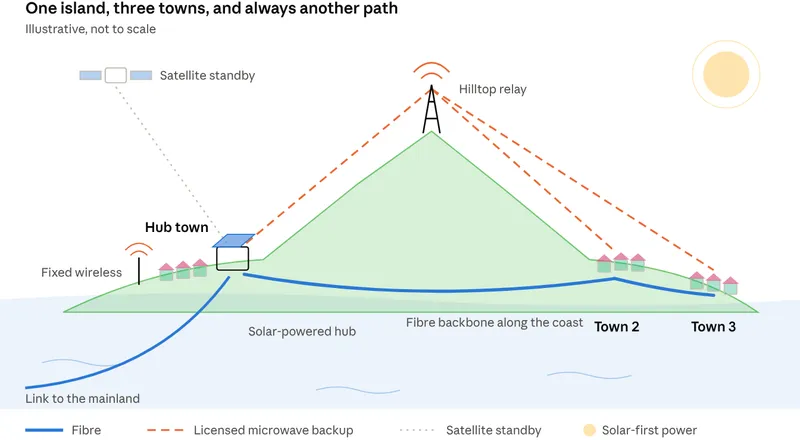
Key components and why we chose them
Mainland fibre connection
Provides the primary upstream connection between the island network and mainland services.
Solar-powered hub
Makes the main-town hub less dependent on unreliable grid power, with grid and generators shown as backup options.
Coastal fibre backbone
Connects the three towns and supports fibre access in town centres.
Licensed microwave backup
Provides an alternate path through a hilltop relay if a section of the fibre backbone is cut, subject to permitting and link survey.
Satellite standby
Offers a separate backup path for essential services if the mainland connection is unavailable.
Fixed wireless access
Extends connectivity to outlying barangays where fibre to each location may be impractical.
Solar-first site power and remote management
Addresses unreliable power and limited local technician availability through resilient power design and secure remote operations.
05Outcome
- 3Towns in the island-wide concept
- ~3,000Homes in the design estimate
- Coastal fibrePrimary island backbone
- Microwave + satelliteBackup paths shown
These are design-scope figures from the supplied case study, not verified deployment results. Route, coverage, capacity, resilience, power autonomy, costs and delivery schedule require site survey, engineering and partner/LGU approval.
06Facing a similar problem?
Request a free site assessment.
Get a free assessment
Tell us about your site and we will recommend a design that fits.