
01The challenge
Case-study scope: This design-stage case study is supplied by NexusOne. The client and exact site are withheld to protect public-safety operations. It is not a verified completed deployment. The reported coverage, capacity, backup runtime and retention figures are design estimates, subject to survey, construction and LGU approval.
Download the supplied case-study report (Word)
The municipality wanted CCTV across its town centre, ports and main roads, but frequent brownouts, typhoons, salt air and lightning could interrupt cameras and exposed infrastructure. There was also no municipal network to carry video back to a control room. Beyond keeping cameras online, the design needed clear responsibility for who could view or export recordings.
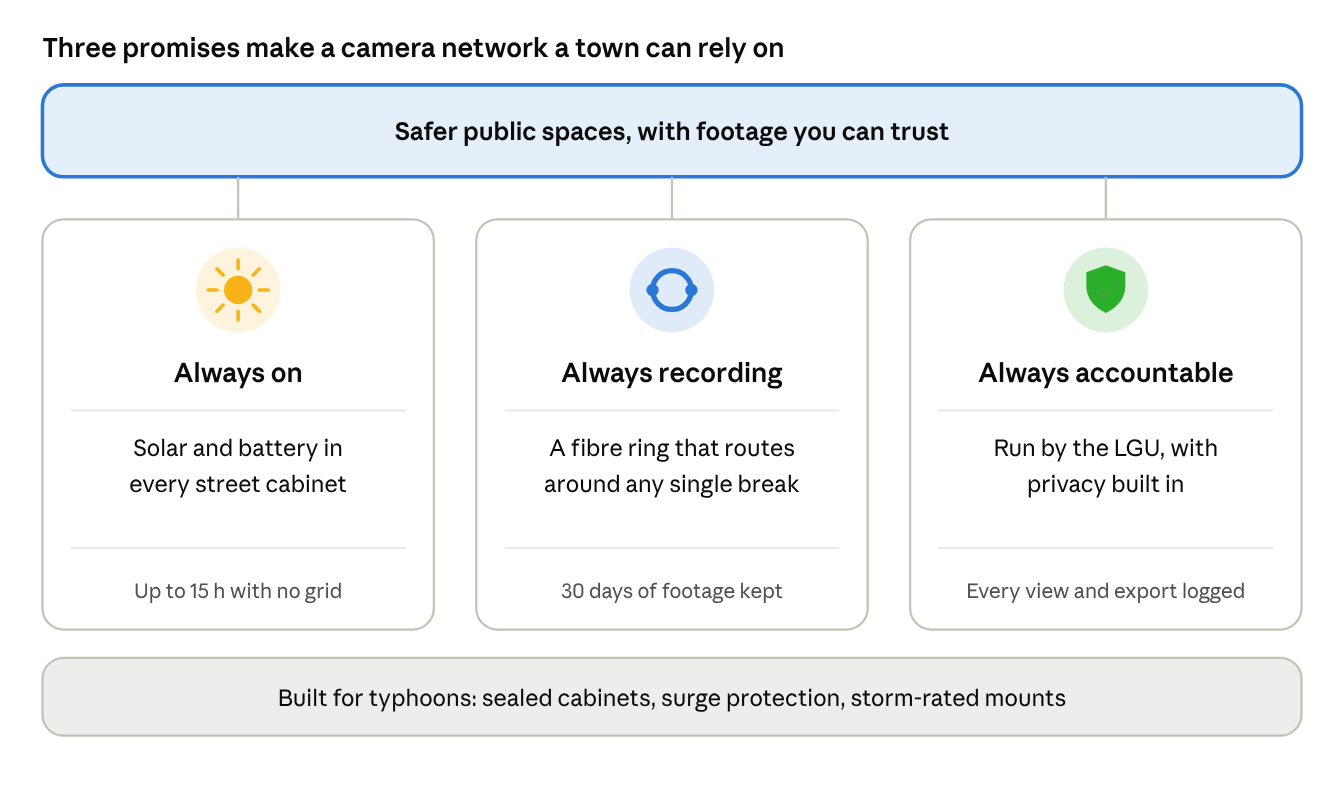
The proposed system combines local backup power with a fibre connection to the municipal control room. The fibre ring is intended to route traffic around one cable break, while solar-powered cabinets reduce dependence on grid power at each street location.
The system is intended to share civil infrastructure with local internet service where that reduces cost, while keeping the CCTV network separate and under LGU control. The original source does not publish detailed routes or site-specific technical configurations.
02Requirements
- Site conditions
- An island municipality in Southern Luzon with frequent brownouts, typhoon exposure, salt air, and no existing municipal network for carrying CCTV video.
- Users
- LGU public-safety staff and specifically authorized personnel who monitor, review or export footage under municipal policy.
- Budget range
- Not stated in the source case study; scope and cost require a site survey and LGU procurement planning.
- Timeline
- Not stated; route, permits, procurement, construction and commissioning dates require confirmation with the LGU.
03Solution design
Assess
The NexusOne concept addresses exposed public spaces, power interruptions, storm conditions, fibre routing, control-room operations and lawful, accountable handling of recorded footage.
Design
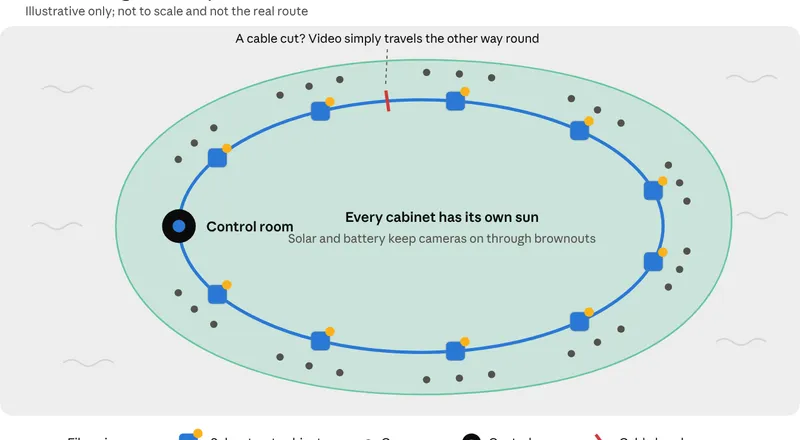
The proposed architecture connects street-level cameras through ten solar-and-battery cabinets on an illustrative 12 km fibre ring to one secure control room. A ring offers an alternate path after a single cable break, while local cabinet power is intended to keep cameras running through grid outages.
Deploy
Before implementation, the LGU and project team would confirm camera locations, fibre routes, pole and cabinet structures, power autonomy, retention settings, network separation, permits and construction quantities. The supplied route diagram is illustrative, not the actual route.
Support
The concept assigns operation to the LGU, with controlled access to footage, logged viewing and exports, and a documented retention policy. Storm readiness includes sealed cabinets, surge protection and storm-rated mounts; maintenance and response arrangements would be agreed before handover.
04Design overview
A high-level view of the design. Detailed addressing, credentials and device configurations are never published.
Key components and why we chose them
Fibre ring
Connects the street cabinets to the control room over an alternate direction if a single section of fibre is cut.
Solar-powered street cabinets
Local solar and battery storage are designed to keep cabinet equipment operating during brownouts, subject to final load and autonomy validation.
Municipal CCTV cameras and control room
Carries video from public areas to an LGU-operated monitoring point for authorized review.
Access and export accountability
Logging each footage view and export supports municipal oversight and responsible handling of sensitive recordings.
Weather and surge protection
Sealed cabinets, surge protection and storm-rated mounts address the coastal and typhoon conditions described in the concept.
05Outcome
- 60+Cameras in the initial design estimate
- 12 kmIllustrative fibre-ring length
- 10Solar-powered street cabinets
- Up to 15 hCabinet runtime without grid power
- 30 daysProposed on-site footage retention
- ~45%Spare capacity in the design
These are design-stage estimates from the supplied case study, not verified installation results. Final routes, quantities, autonomy and retention must be confirmed during survey, engineering and LGU approval.
06Facing a similar problem?
Request a free site assessment.
Get a free assessment
Tell us about your site and we will recommend a design that fits.