
The challenge
The university scenario retains the original scale: around 60,000 students and 5,750 staff across 16 campuses, with substantial growth expected. The proposal considers modern needs such as personal and managed devices, cloud services, remote access, high availability and recovery from disruptive incidents.
Part 1: Modern network design
The proposal replaces location-based trust with checks based on identity, device health and context, joining a segmented campus fabric to cloud services and remote users.
Campus fabric
A redundant, automated campus design uses role-based segmentation across wired and wireless access. The proposal includes Wi-Fi 7, secure enterprise wireless and managed device posture.
WAN and cloud
SD-WAN uses diverse MPLS, broadband and cellular links with application-aware routing. Azure is the primary data centre, connected through a cloud hub and private connectivity.
Identity-aware access
Users and devices are verified before access is granted. Remote staff and students are proposed to use per-application access rather than broad network-level VPN access.
Operations and automation
Configuration as code, telemetry and centralized security monitoring are intended to improve consistency, detect changes and support recovery across the estate.
Figure 4. FNU 2026 hybrid Zero Trust architecture
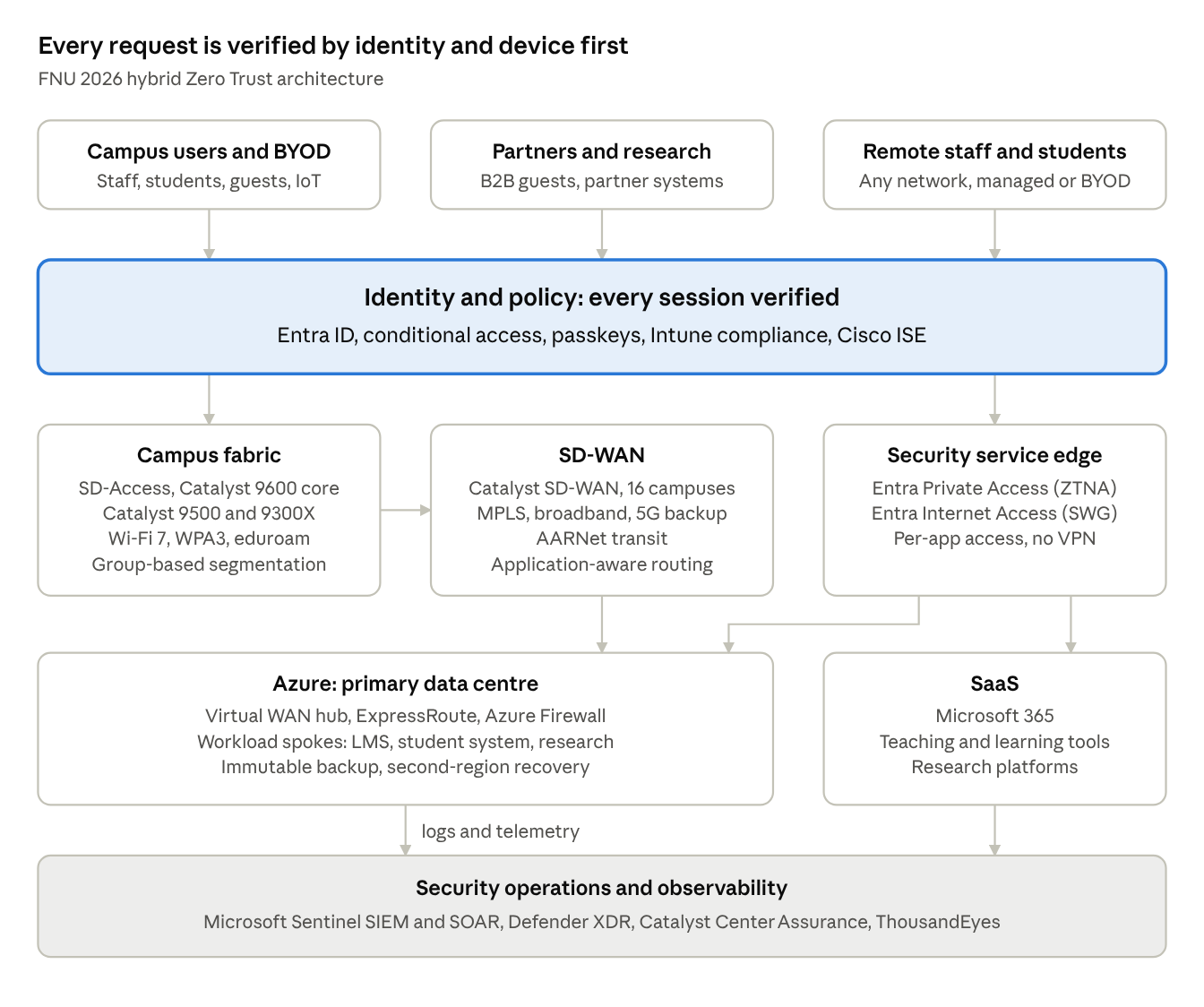
This is a conceptual proposal, not a deployed topology or implementation guide. The 2026 design elements have not been lab-tested.
Part 2: Security program and recovery
The security program is organized around governance, threat and asset management, the Essential Eight baseline, policy, and ransomware-focused recovery. The report aligns the proposed program with NIST CSF 2.0 and ISO/IEC 27001:2022 and describes privacy and breach-response responsibilities for the Australian scenario.
Recovery objectives in the proposal
- 99.95%availability target for critical services
- 15 minrecovery-point objective for critical services
- 4 hrrecovery-time objective for critical services
| Service tier | Example services | RPO | RTO |
|---|---|---|---|
| Critical | Identity, learning management, student system and network core | 15 minutes | 4 hours |
| Urgent | Email, collaboration, telephony and ERP | 1 hour | 24 hours |
| Important | Research file services and departmental applications | 24 hours | 72 hours |
| Normal / non-essential | Archives and lower-priority facilities systems | 24 hours | 7–30 days |
The proposed recovery approach uses protected, immutable backups, recovery in a second region, a clean recovery environment and scheduled restore exercises. Identity is prioritized during restoration so other services can be brought back safely.
Governance and controls
Proposed controls include phishing-resistant sign-in, device compliance, least-privilege administration, segmented network access, cloud policy guardrails, centralized security monitoring, and documented incident response. The report sets validation plans for these controls; it does not claim that the 2026 recommendations have passed those tests.
Part 3: Proven lab controls and 2026 validation plan
The source distinguishes five controls that passed tests in the original 2018 Azure lab from the proposed 2026 controls, which still require validation.
| Control | Original lab result | 2026 proposal |
|---|---|---|
| Backup and recovery | A server was restored from an Azure Recovery Services vault. | Immutable and cross-region backups, with clean-room restore exercises. |
| Identity | A server joined managed domain services and synchronized users and groups. | Entra ID, conditional access, passkeys and privileged access management. |
| File service | Folder permissions and audit logging were tested in a Windows FTP lab. | Use managed collaboration or a protected file-transfer service instead of clear-text FTP. |
| Load balancing | Traffic failed over between two lab web servers when one was stopped. | Use supported load-balancing services, private back ends and protected administration. |
| Remote access | Certificate-based lab access accepted an authorized client and rejected a client without a certificate. | Use per-application Zero Trust access with identity and device checks. |
New 2026 controls are intended to be built in a non-production environment, tested against defined outcomes, and monitored before being considered operational. The report emphasizes recovery tests, segmentation checks, identity controls and security telemetry.
What changes from 2018 to 2026?
| Area | Earlier design | 2026 proposal |
|---|---|---|
| Trust and access | Perimeter controls and point-to-site VPN | Verify each session; grant per-application access |
| Campus segmentation | VLANs and access lists | Identity- and role-aware segmentation |
| WAN | MPLS replacing Frame Relay | SD-WAN across private and internet links with application-aware routing |
| Operations | Manual device-by-device change | Reviewed configuration as code, telemetry and drift detection |
| Recovery | Backups and a warm site | Immutable backups, clean-room recovery and defined recovery objectives |
Outcomes and lessons
The proposal makes identity, recovery and automation central to a modern campus design. Its principal lessons are to verify users and devices rather than trust location, treat security and performance as connected, rehearse recovery, and review designs as technology and threats change.
Related case study
Read the original network redesign and its limited proof-of-concept results.
University network security redesign