
01The challenge
The developer was marketing homes to young families and remote workers, and buyers kept asking the same question: “Is there fiber?” Without a plan, each household would have to arrange its own connection after moving in, with long waits and overhead cables strung along the streets.
The developer needed a connectivity partner that could make the subdivision internet-ready at turnover, keep the streetscape clean, and grow the network as new phases were completed.
02Requirements
- Site conditions
- New subdivision with roads and utility easements in place, homes turned over in phases.
- Users
- Future homeowners, the homeowners' association office, the clubhouse and the guardhouse.
- Budget range
- Developer-funded backbone; per-home connection billed under each household's plan.
- Timeline
- Backbone for Phase 1 ready before the first turnovers, Phase 2 added as construction progresses.
03Solution design
Assess
We walked the site with the developer's engineers, mapped easements and turnover phases, and estimated the number of connections over five years.
Design
We designed a fiber hub with splitter cabinets per phase, so the network grows with occupancy instead of being overbuilt on day one.
Deploy
Feeder fiber and cabinets were placed along existing easements, with drop fiber run to each home only when a household subscribes.
Support
Residents get local support and a single point of contact, and the HOA receives a simple monthly service summary.
04Design overview
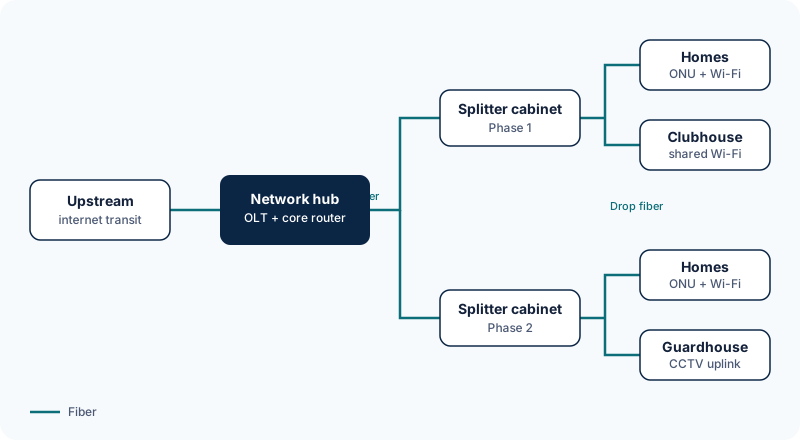
A high-level view of the design. Detailed addressing, credentials and device configurations are never published.
Key components and why we chose them
Central network hub
One secured location for core equipment simplifies maintenance and future upgrades.
Splitter cabinets per phase
Lets the developer fund the network in stages that match construction and turnover.
On-demand drop fiber
Avoids paying for connections to homes that are not yet occupied.
Shared Wi-Fi for amenities
Gives the clubhouse and guardhouse reliable connectivity, including a CCTV uplink.
05Outcome
- 250Lots covered by the design
- 2Build phases
- 3–5 daysTypical install after request
Sample quote. Replace with a real client testimonial.
06Facing a similar problem?
Request a free site assessment, or download the full design brief.
Get a free assessment
Tell us about your site and we will recommend a design that fits.
Download the full design brief
We will email you a private download link. It stays valid for 7 days.